
Curtains are the single biggest textile in any Dubai room, and getting the size wrong is the single most common curtain-buying mistake we see. A curtain that is too narrow will not close across the window and leaves a permanent strip of harsh Dubai sunlight streaming in. A curtain that is too short looks like a half-finished renovation. A curtain that is too long puddles on the floor, collects the dust that every Dubai home fights daily, and frays within months. None of these are problems you can fix after the curtains are made — which is why knowing how to measure for curtains properly, before you order, is genuinely the most important step in the whole process.
The good news is that curtain measuring is not complicated. It is two measurements — width and drop — taken in the right place, with a small allowance for the heading type and a sensible decision about how full you want the curtain to look when closed. The framework in this guide is adapted from the well-established method used by professional curtain fitters, and it works for every curtain type sold in Dubai: ready-made eyelet panels, made-to-measure pencil pleat drapes, blackout bedroom curtains, sheer voiles, motorized tracks, and everything in between.
This guide walks through the tools you need, the two measurements you take, the difference between measuring for eyelet and pencil pleat headings, how to choose your drop length, how to calculate the right curtain width for the look you want, and the Dubai-specific adjustments that catch first-time buyers off guard. By the end you will have the exact numbers you need to order curtains that fit your window perfectly — or to brief a made-to-measure supplier with confidence.
1. What You Need Before You Start Measuring
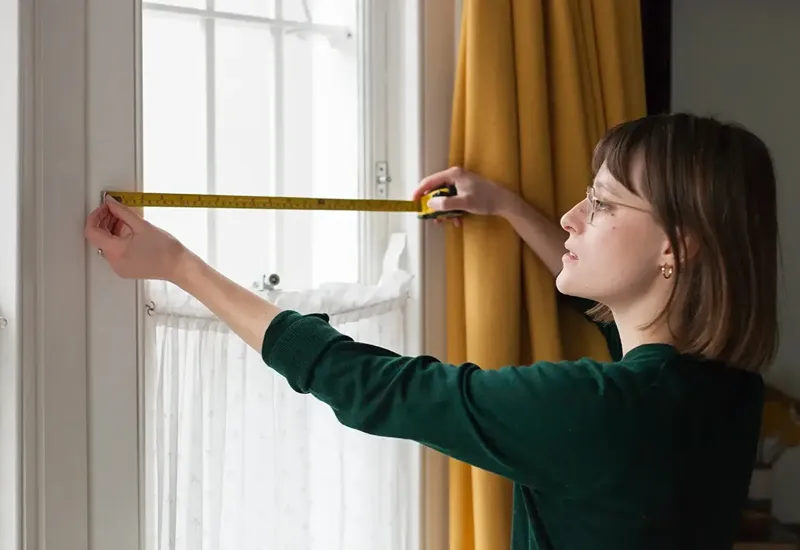 Measuring for curtains is not a job that requires specialist equipment, but it does require a few basic tools and one important decision made before the measuring tape comes out. Skipping either of these is the most common reason for ending up with curtains that do not fit.
Tools
You need a steel tape measure — not a fabric tailor’s tape, which stretches and sags and will give you a width that is off by a couple of centimetres over a wide window. A 5 metre steel tape is plenty for almost any residential window; for full-height living room windows or bay windows, a 7 or 8 metre tape is more comfortable. You also need a stepladder (to reach the top of the window recess comfortably and safely), a pencil, and a piece of paper to write the measurements down — do not trust them to your phone, because a misread digit is the second most common measuring mistake after using the wrong tape.
Fit the pole or track first
This is the golden rule of curtain measuring, and it is the one step most DIY buyers skip. If you have not yet fitted your curtain pole or track, fit it before you measure for the curtains. The pole or track position determines where the curtain hangs, how wide it needs to be, and where the drop starts — and any measurement taken before the pole is in place is a measurement based on a guess about where the pole will end up. If you absolutely cannot fit the pole first, the section below on measuring without a pole gives you the workaround, but the right answer is to fit the pole, then measure.
If you need help fitting the pole or track itself, our curtain installation service covers the entire Dubai area and handles pole fitting, track mounting, motorized track wiring, and the curtain hanging itself. Many homeowners find that having a professional fit the pole eliminates the most common source of measuring errors.
A helper, ideally
Measuring a wide window on your own is doable but awkward — the tape sags across a wide span, and reading the far end of the tape while holding the near end is genuinely tricky. A second pair of hands makes the job faster, more accurate, and safer if you are using a stepladder. If you are measuring a full-height villa window (3 metres or more), a helper is closer to a necessity than a convenience.
2. Step One: Measure the Curtain Width
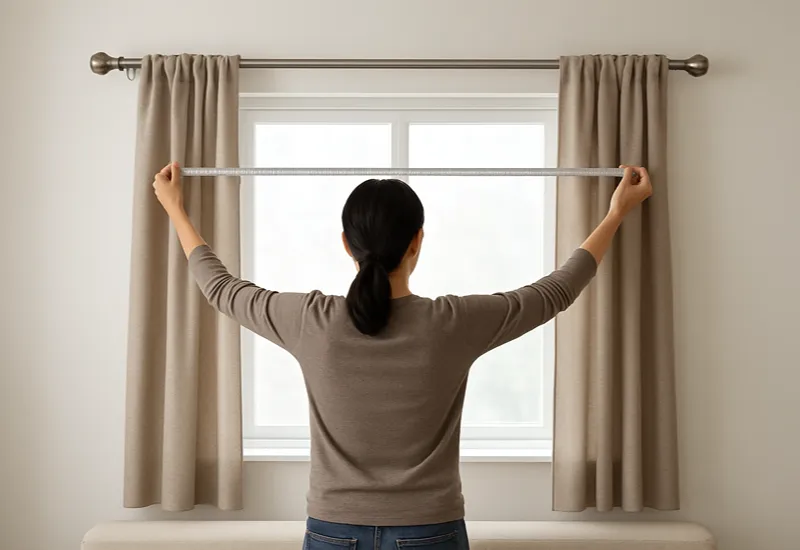 Curtain width is the first of the two measurements you need, and it is the one most often taken in the wrong place. The width you write down is not the width of the window, and it is not the width of the wall — it is the width of the curtain pole or track, excluding the decorative finials at each end.
If you have a curtain pole fitted
Measure the full width of the pole from one bracket to the other, not including the finials (the decorative ends that screw onto the pole). The finials are not part of the usable pole — the curtain cannot slide past the bracket, so the finial width is irrelevant to the curtain measurement. Write this number down as your pole width. For example, if the pole is 200 cm wide between the brackets, your pole width is 200 cm, even if the finials add another 8 cm to the total visible pole length.
If you have a curtain track fitted
Measure the full width of the track, including any overlap in the middle (many tracks have a small built-in overlap so the two curtain panels meet without a light gap). If the track is inside the window recess, the track width is your measurement. If the track is fitted outside the recess (the more common setup in Dubai, because it allows the curtain to stack back off the window), measure the full track width including the parts that extend past the window on each side.
If no pole or track is fitted yet
If you have not fitted a pole or track yet, measure the width of the window itself and add 40 cm — roughly 20 cm on each side — to allow for the pole to extend past the window and for the curtain to stack back off the glass when open. So a window that is 180 cm wide would need a pole of approximately 220 cm. This is the same approach Dunelm and other major curtain retailers recommend, and it works because the extra width on each side gives the curtain somewhere to gather when open, instead of blocking part of the window. Once the pole is fitted, re-measure to confirm — the actual fitted width may differ slightly from your calculated width.
3. Step Two: Measure the Curtain Drop
 Curtain drop, also called curtain length, is the second measurement — and it is the one where the heading type genuinely matters. The starting point for the drop measurement depends on whether you have eyelet curtains or pencil pleat curtains, and getting this wrong is the single most common reason curtains come back the wrong length.
For eyelet curtains
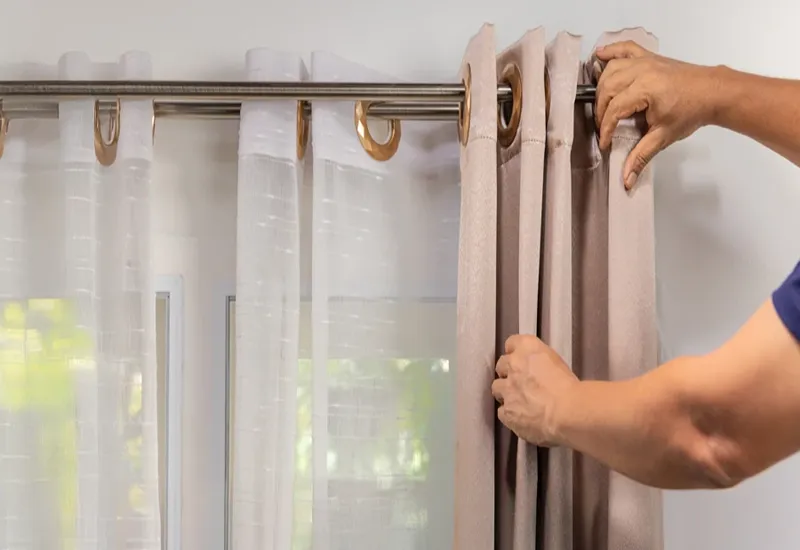
Eyelet curtains (also called ring-top curtains) have metal rings sewn into the top of the fabric, and they hang directly on the pole by threading the pole through the rings. Because the curtain hangs from the top of the pole, the drop measurement starts from the top of the pole — not from the bottom of the ring, and not from the bracket. Place the start of your tape on the very top of the pole, and measure down to where you want the curtain to end. This is your eyelet drop.
For pencil pleat curtains
Pencil pleat curtains have a gathered fabric heading that hooks onto curtain rings (if used with a pole) or gliders (if used with a track). Because the curtain hangs from the hooks, not from the top of the pole, the drop measurement starts from the eye of the curtain ring (the small metal loop the hook passes through) or from the top of the track if no rings are used. Place the start of your tape at the eye of the ring, and measure down to where you want the curtain to end. This is your pencil pleat drop.
If no pole or track is fitted yet
If you are measuring before a pole or track is fitted, take your drop measurement from where the top of the pole will sit (typically 10 to 15 cm above the top of the window recess), and add 10 cm to the drop to allow for the pole and ring position. This is an approximation — once the pole is fitted, re-measure to confirm before ordering made-to-measure curtains.
4. Choosing Your Drop Length: Four Standard Options
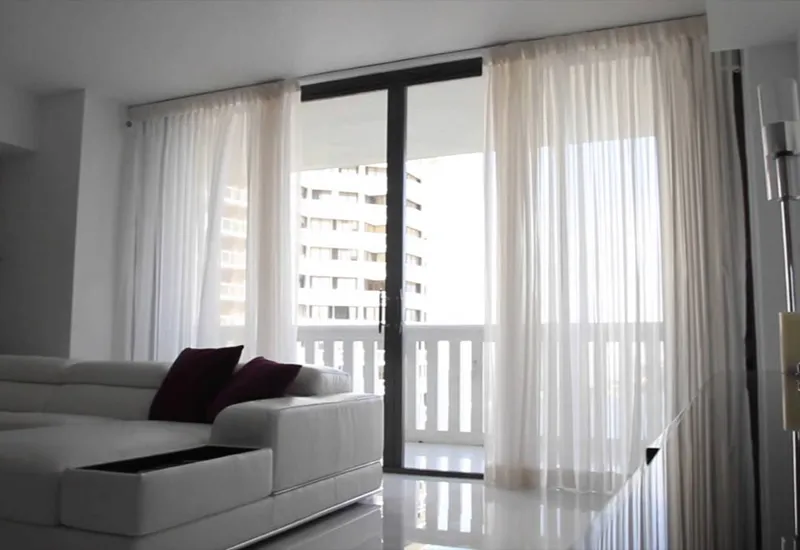 Once you know where the drop starts, you need to decide where it ends. There are four standard curtain drop lengths, and each one suits a different room and a different style. None is universally right or wrong — the choice is a design decision as much as a practical one.
| Drop style | Ends where | Best for |
|---|---|---|
| Windowsill | 1 cm above the windowsill | Kitchens, bathrooms, and small windows where the sill is a feature. Practical and tidy. |
| Apron | 15 cm below the windowsill | Bedrooms and living rooms where the curtain needs to clear a radiator or sill but not reach the floor. |
| Floor-length | 1 cm above the floor | The most popular choice for Dubai living rooms and bedrooms. Looks finished, blocks light, easy to keep clean. |
| Puddle | 2-7 cm below the floor | Formal living rooms and master bedrooms. Luxurious pooling effect, but collects more dust. |
Floor-length is the default choice in most modern Dubai interiors, and it is the drop we recommend unless you have a specific reason to choose otherwise. It looks intentional and finished, it blocks more light than shorter drops (because there is no gap at the bottom for light to leak through), and it stays cleaner than a puddle drop because the hem is not sitting on the floor collecting dust. Puddle drops are beautiful in a formal master bedroom or a luxury living room, but they require more frequent cleaning and are not practical in a home with pets or young children.
One Dubai-specific note: if you have underfloor heating or a baseboard AC unit under the window, do not let the curtain puddle on the floor in front of it — the trapped heat or cold air reduces the unit’s efficiency and can damage the curtain fabric over time. Use a windowsill or apron drop in those cases, or fit the curtain to clear the unit by at least 5 cm.
5. Calculating Curtain Width: The Fullness Ratio
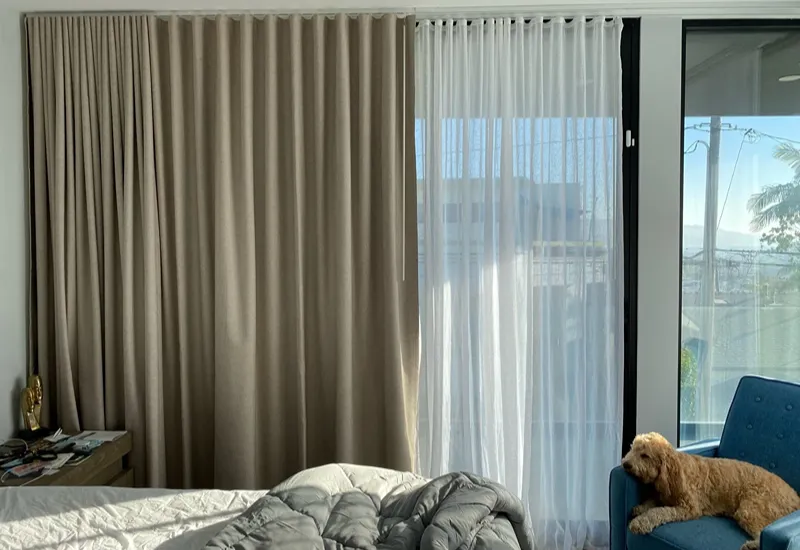 Here is the part that catches most first-time curtain buyers. The width of the curtain you order is not the same as the width of the pole. Curtains need fullness — extra fabric — to gather into soft folds when closed. Order a curtain the same width as the pole, and you will get a flat, stretched sheet of fabric with no gathers at all. Order one twice the pole width, and you get the standard gathered look most homeowners want. Order one two-and-a-half times the pole width, and you get a luxurious, full, deeply-folded look.
The golden rule
Each individual curtain panel (one half of the pair) should be at least as wide as the full pole, to provide a full look when both panels are closed together. So for a 200 cm pole, each curtain panel should be at least 200 cm wide — meaning the pair, laid flat, totals at least 400 cm of fabric. This is the 2x fullness ratio, and it is the standard for most ready-made curtains.
Standard vs luxury fullness
- Standard gather (2x fullness): Each panel equals the pole width. The pair, laid flat, is twice the pole width. This is the default for ready-made curtains and gives a normal, even gathered look when closed. Most off-the-shelf curtain pairs are designed to this ratio.
- Luxury gather (2.5x fullness): Each panel is 1.25 times the pole width. The pair, laid flat, is two-and-a-half times the pole width. This gives a fuller, more opulent look with deeper folds — the standard for high-end made-to-measure curtains, hotel drapes, and formal living rooms. Use this ratio for velvet, silk, or any heavy fabric where the depth of the fold is part of the design.
Ready-made curtain sizing
Ready-made curtains are sold in pairs, and the size on the pack refers to each individual curtain panel, not the pair. So a pack labelled “117 x 137 cm” contains two panels, each 117 cm wide and 137 cm long. To check whether a ready-made pair fits your pole, divide your pole width by the panel width — if the result is around 2, you have standard fullness; if it is around 2.5, you have luxury fullness; if it is much less than 2, the curtains will look stretched and you should size up.
6. Eyelet vs Pencil Pleat: Which Heading, Which Measurement
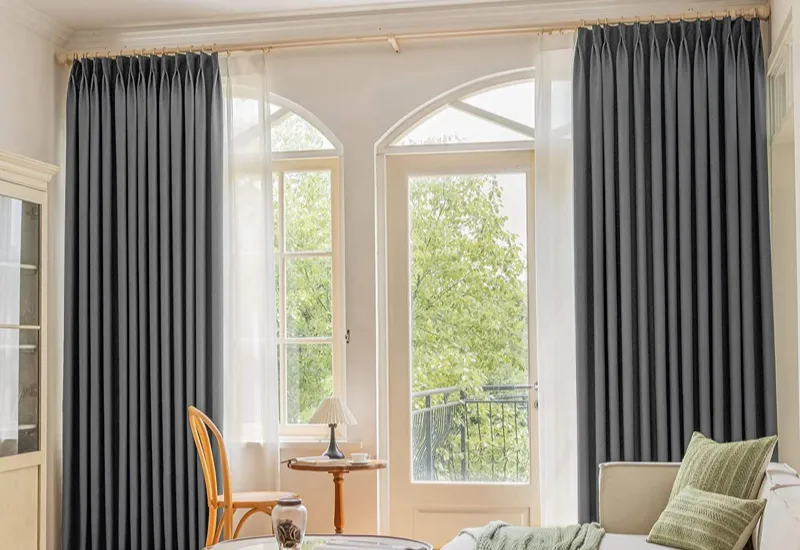 The curtain heading — the way the top of the curtain is constructed — affects both how the curtain looks and how you measure for it. The two most common headings sold in Dubai are eyelet and pencil pleat, and the measuring difference between them is the single most common source of ordering errors.
| Feature | Eyelet | Pencil pleat |
|---|---|---|
| How it hangs | Metal rings sewn into the top, pole threaded through | Gathered fabric heading, hooks onto rings or track gliders |
| Drop starts from | Top of the pole | Eye of the curtain ring, or top of the track |
| Look | Modern, large soft folds, contemporary | Traditional, tight even gathers, classic |
| Best for | Living rooms, bedrooms, modern interiors | Traditional rooms, tracks, bay windows, layered with sheers |
| Fullness ratio | Fixed by the ring spacing, usually 1.5-1.7x | Adjustable, typically 2x or 2.5x |
| Bay window friendly? | No — pole cannot bend around corners | Yes — track follows the bay shape |
If you are buying ready-made curtains, the heading is decided for you — eyelet is the dominant style in the ready-made market, and our eyelet curtains range covers most of the ready-made options. If you are going made-to-measure, the heading is your choice, and the right call depends on the room and the look you want. Eyelet for a clean modern living room or bedroom, pencil pleat for a traditional interior or for any window where a track is needed instead of a pole.
7. Dubai-Specific Measuring Notes
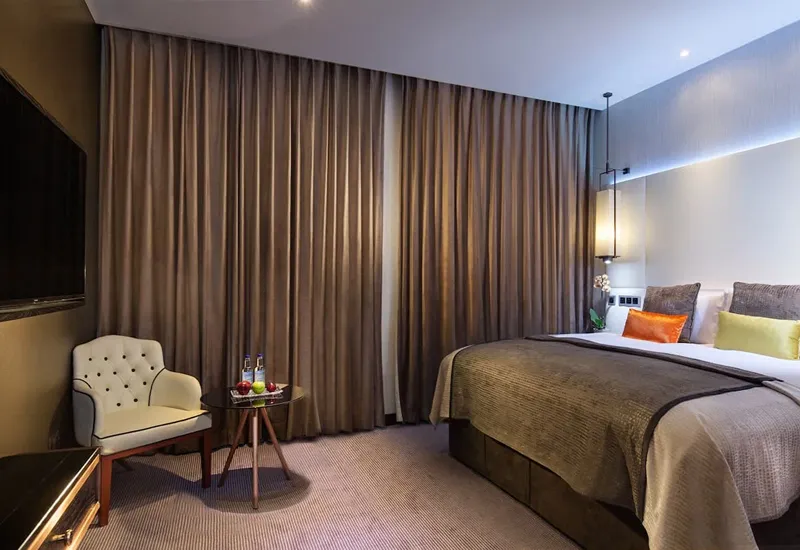 Three local factors shape curtain measuring in Dubai in ways that international buyers may not anticipate. Ignoring them is the most common reason a curtain order comes back looking wrong even when the measuring was technically correct.
Sun exposure dictates fabric choice, which dictates width
Dubai’s sun is harsh enough to fade curtain fabric within a year of direct exposure, and it generates enough heat at the window to make a thin curtain effectively useless. For any window that faces west or south — which is most windows in a Dubai villa or apartment — a blackout curtain or a heavily-lined drape is genuinely worth the investment. Blackout fabric is heavier and stiffer than standard curtain fabric, which means it does not gather as tightly — plan for closer to 2.5x fullness rather than 2x to get the same gathered look, because the folds will be deeper and stiffer.
For a layered look (sheer under a drape, which is the standard setup in most Dubai living rooms and master bedrooms), measure the sheer and the drape separately. The sheer curtain hangs on a tension rod or a thinner inner track inside the recess, and its drop is typically to the sill or apron. The outer drape hangs on the main pole or track and runs full length to the floor. The two are measured independently, and the layered look only works if the sheer is at least 2x fullness and the drape is at least 2.5x.
Bay windows need a track, not a pole
Many Dubai villas (Arabian Ranches, Meadows, Springs, Palm Jumeirah) have bay windows in the living room or master bedroom. A curtain pole cannot bend around the corners of a bay, so bay windows require a flexible curtain track that follows the shape of the bay. This means pencil pleat curtains (which work with tracks) rather than eyelet (which require a straight pole). Measuring for a bay is more involved: measure each straight section of the bay separately, add them together for the total track length, and use that as your width. The drop is measured the same way as a straight window, but take measurements at multiple points around the bay because floor-to-pole height can vary by a centimetre or two across the bay.
Motorized tracks need a power point
Motorized curtains are increasingly popular in Dubai, particularly for high windows, full-height living room drapes, and hard-to-reach bedroom windows. Measuring for a motorized track is the same as measuring for a manual track in terms of width and drop, but you also need to plan for the power supply. The motor sits at one end of the track and needs a nearby power point — ideally a dedicated outlet fitted at the same height as the track, on the side where the motor will sit. If you are planning motorized curtains, factor in the electrical work as part of the measuring and fitting process, not as an afterthought. Browse our motorized curtains range to see the track and motor options currently available.
Floor-to-ceiling windows in apartments
Dubai Marina, Downtown, and Business Bay apartments typically have full-height glazing from floor to ceiling, often 2.7 to 3.2 metres tall. These windows need curtains that run the full height, and the drop measurement has to be precise — a 1 cm error over 3 metres is visible. Measure the drop at three points across the window (left, centre, right) because floors are rarely perfectly level, and use the shortest measurement as your drop. Adding 1 cm of clearance above the floor is standard; anything more looks like a mistake on a full-height window.
8. Which Curtain Style Suits Which Room?
 The decision matrix below maps the most common Dubai rooms to a recommended curtain style, heading, and drop. Use it as a starting point, then confirm the choice against your actual interior and the way you use the room.
| Room | Recommended style | Heading and drop |
|---|---|---|
| Master bedroom | Blackout, lined | Eyelet or pencil pleat, floor-length, 2.5x fullness. Layer with sheer. |
| Living room | Velvet or faux silk, lined | Eyelet, floor-length, 2.5x fullness. Layer with sheer under. |
| Kids’ room | Blackout, durable fabric | Eyelet, floor-length or apron, 2x fullness. Avoid long puddles. |
| Kitchen | Cotton or linen, washable | Eyelet, windowsill drop, 2x fullness. Short for safety near heat. |
| Bathroom | Moisture-resistant, sheer or cotton | Eyelet, windowsill or apron, 2x fullness. Avoid floor-length. |
| Office | Blackout or solar-control | Eyelet or motorized track, floor-length, 2x fullness. See our office curtains range. |
| Bay window (villa) | Pencil pleat on bent track | Pencil pleat, floor-length, 2.5x fullness. Track follows bay shape. |
| Floor-to-ceiling (apartment) | Motorized, blackout-lined | Motorized track, full height to 1 cm above floor, 2.5x fullness. |
Quick Reference — Measuring for Curtains in Dubai
- Tools: Steel tape measure (5-8m), stepladder, pencil and paper. Fit the pole or track first.
- Width: Measure pole between brackets (excl. finials) or full track length. No pole yet? Window width + 40cm.
- Drop (eyelet): From top of pole down to where curtain should end.
- Drop (pencil pleat): From eye of curtain ring (or top of track) down to where curtain should end.
- Drop length options: Windowsill (1cm above sill), apron (15cm below sill), floor-length (1cm above floor), puddle (2-7cm on floor).
- Fullness ratio: Standard 2x (each panel = pole width). Luxury 2.5x (each panel = 1.25 x pole width). Heavier fabrics need 2.5x.
- Dubai notes: West/south windows need blackout + 2.5x fullness. Bay windows need a bent track and pencil pleat. Motorized tracks need a power point. Floor-to-ceiling: measure drop at 3 points, use shortest.
- Ready-made packs: Size on the pack is per panel, not per pair. A 117x137cm pack = two 117x137cm panels.
9. The Five Most Common Curtain Measuring Mistakes
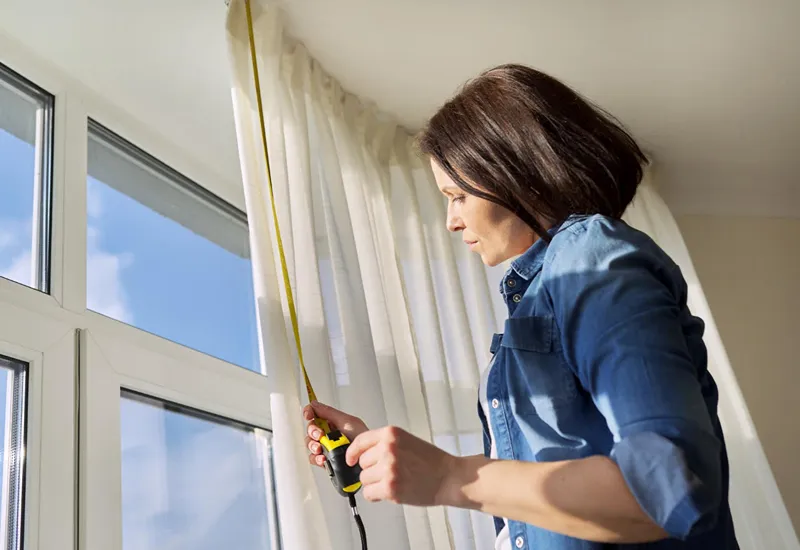 Most curtain measuring errors fall into one of five categories. Each is easy to make and easy to avoid once you know to look for it.
- Mistake 1 — Measuring the window instead of the pole. The window width is irrelevant to the curtain size. The curtain hangs from the pole, so the pole width is what you need. If no pole is fitted, use window width + 40 cm as a placeholder, then re-measure once the pole is up.
- Mistake 2 — Including the finials in the pole width. Finials are decorative ends that screw onto the pole. The curtain cannot slide past the bracket, so the finial width is not usable pole. Measure between the brackets, not between the finials.
- Mistake 3 — Using the same drop start for eyelet and pencil pleat. Eyelet curtains hang from the top of the pole, pencil pleat curtains hang from the eye of the ring. Mixing these up gives a drop that is wrong by 5 to 8 cm — enough to look obviously off but not enough to be obviously why.
- Mistake 4 — Ordering the pole width as the curtain width. A curtain the same width as the pole will be a flat sheet with no gathers. Always apply the fullness ratio: 2x for standard, 2.5x for luxury. Each panel should be at least the pole width.
- Mistake 5 — Measuring only once. Curtain measuring is a measurement you cannot easily correct after the curtains are made. Measure twice, in two places (left side and right side of the pole, three points across a wide window), and use the shortest or most consistent figure. The five minutes it takes to double-check is the cheapest insurance you will ever buy on a home project.
10. Next Steps: From Measurements to Fitted Curtains
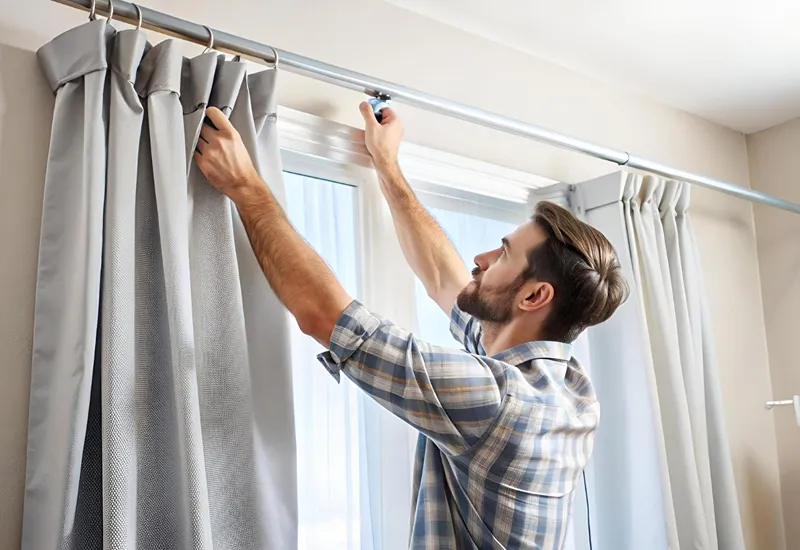 If you have read this far, you now have the framework to measure any window in your home for curtains — and to brief a supplier with confidence. The fastest way to lock the decision is to write down your measurements for each room, choose the curtain style and heading that suits each space, and then either order ready-made panels or request a made-to-measure quote.
Step 1 — Measure each window
Use the framework in Sections 2 and 3 to measure width and drop for each window you want to curtain. Note the heading type (eyelet or pencil pleat), the drop style (windowsill, apron, floor-length, or puddle), and the fullness ratio you want. Use the decision matrix in Section 8 as a starting point if you are unsure which style suits each room.
Step 2 — Browse the curtain ranges
Once you have your measurements, browse the dubaicurtain.com ranges to find the right curtain for each room. For bedrooms, start with blackout curtains and bedroom curtains. For living rooms, look at living room curtains and the sheer curtains range for layering. For offices and commercial spaces, the office curtains range covers blackout and solar-control options. For high or hard-to-reach windows, browse the motorized curtains range. The full shop page lists everything currently in stock, and the eyelet curtains page covers the ready-made eyelet range.
Step 3 — Book a measuring visit or fitting
If you would rather have a professional take the measurements — particularly for bay windows, full-height apartment windows, or motorized track installations — use our curtain installation service or the Contact Us page to book a free measuring visit anywhere in Dubai. Our team brings sample fabrics, measures each window accurately, advises on heading and fullness choices, and provides a written quote with no obligation. A typical home visit takes 30 to 45 minutes for a 2 to 3 bedroom apartment and an hour for a villa, and it eliminates the measuring mistakes that no online guide can fully prevent. Call +971 50 637 9229 or visit our blog for more curtain and blinds guides.
Whatever you choose, take the time to measure properly before ordering. A curtain that fits the window exactly is genuinely transformative — it blocks light, manages heat, softens the room acoustically, and finishes the interior in a way no other single element can. A curtain that is the wrong size, however beautiful the fabric, never quite looks right. Five minutes with a tape measure is the difference between the two. — Editor, dubaicurtain.com/blog


